
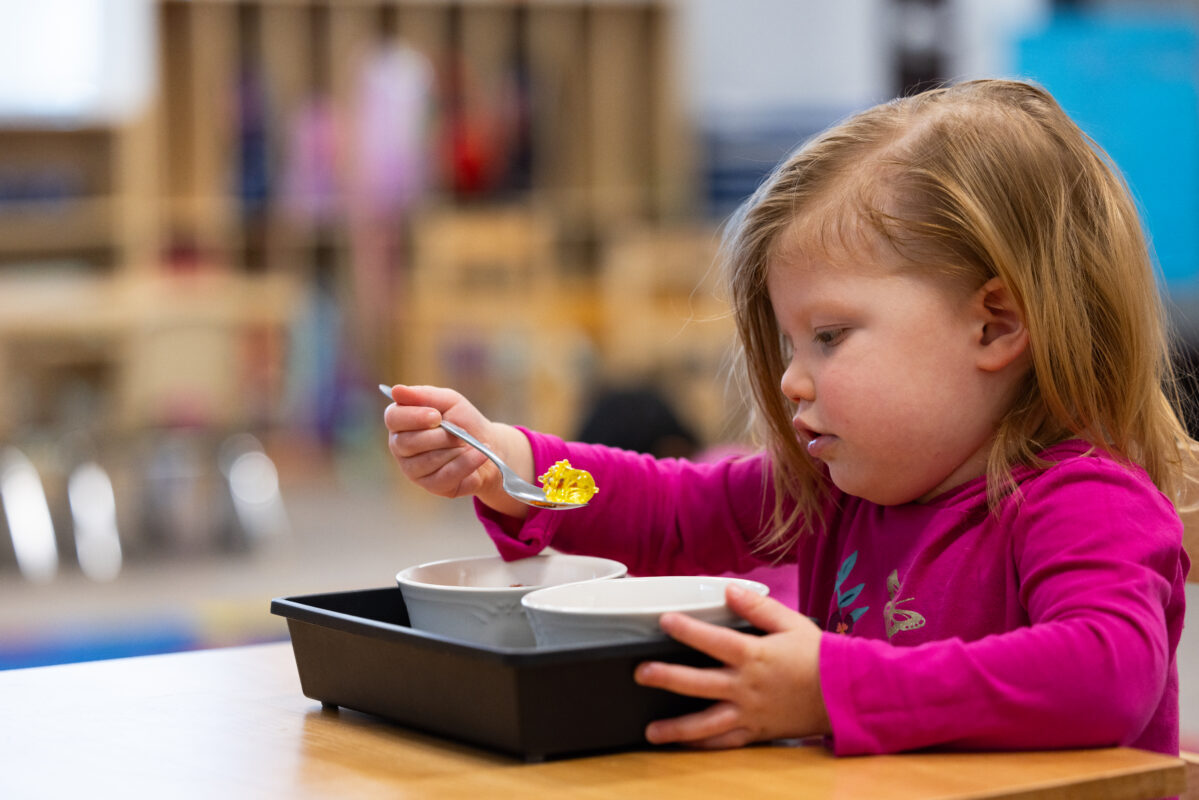
In a Montessori classroom, Practical Life is often the first area that draws a child’s interest. Pouring water, washing a table, buttoning a frame, or carefully transferring objects with a spoon may appear simple on the surface, yet these activities are foundational to a child’s cognitive, emotional, and neurological development. Practical Life is not “practice for later.” It is real work that directly supports the development of executive functioning skills during the most important years of brain growth, from birth through age six.
Executive functioning refers to a set of mental processes that allow children to plan, focus attention, remember instructions, manage impulses, and carry out multi-step tasks. These skills include working memory, cognitive flexibility, self-control, emotional regulation, and sustained attention. Research in developmental psychology and neuroscience consistently shows that strong executive functioning in early childhood is a better predictor of long-term academic success, social competence, and well-being than early academic skills alone. Montessori Practical Life activities are intentionally designed to strengthen these skills at the exact moment the brain is most receptive to forming them.
Dr. Maria Montessori observed that young children have sensitive periods, or windows of heightened brain plasticity, during which they are especially drawn to certain types of learning and can acquire skills with remarkable ease. From birth to around age six, children experience sensitive periods for movement, order, concentration, coordination, independence, and refinement of the senses. Practical Life directly aligns with these sensitive periods. When children repeatedly engage in purposeful, hands-on tasks, they are not only satisfying an internal developmental need, they are literally building neural pathways that support executive functioning.
During the sensitive period for movement, children feel an intense drive to move with purpose. Practical Life channels this need into meaningful activity. Carrying trays, scrubbing tables, sweeping floors, and pouring liquids require controlled, intentional movement. Neuroscience research shows that movement and cognition are deeply connected. Activities that involve coordinated movement activate the prefrontal cortex, the area of the brain responsible for executive functions such as planning and self-regulation. Rather than separating physical activity from learning, Montessori integrates them, strengthening both simultaneously.
The sensitive period for order, which is especially strong between ages one and four, is also supported through Practical Life. Montessori environments are carefully structured, and Practical Life activities follow a clear beginning, middle, and end. A child selects work from the shelf, completes the task step by step, cleans up, and returns the material to its place. This external order supports the child’s internal sense of order. Research in child development indicates that predictable routines and orderly environments help young children develop cognitive organization and impulse control. Over time, this repeated experience of order becomes internalized, supporting planning skills and logical thinking.
Concentration is another key sensitive period that Practical Life nurtures. Many executive functioning challenges stem from difficulty sustaining attention. Montessori observed that children naturally develop deep concentration when they are engaged in purposeful, self-chosen work that matches their developmental level. Practical Life activities are designed to isolate difficulty and allow children to repeat tasks as often as needed. Studies on attention development show that self-directed, hands-on activities promote longer attention spans than passive or adult-directed tasks. When a child pours water carefully without spilling or fastens buttons with precision, they are practicing sustained focus, error control, and perseverance, all essential components of executive functioning.
Self-regulation and impulse control are also developed through Practical Life. Each activity requires the child to slow down, control their movements, and follow a sequence. A child must wait their turn to carry a tray, move carefully to avoid spills, and pause to correct mistakes independently. Modern neuroscience confirms that these moments of self-control strengthen the neural connections in the prefrontal cortex. Importantly, Montessori environments support regulation without external rewards or punishments. The work itself provides feedback, allowing children to develop internal control rather than relying on adult correction.
Working memory, another core executive function, is constantly engaged during Practical Life activities. Children must remember the sequence of steps involved in washing hands, preparing a snack, or polishing an object. Over time, these repeated sequences strengthen memory pathways and support the ability to hold and manipulate information in the mind. Research shows that working memory is highly malleable in early childhood and improves through activities that require planning and sequential thinking, exactly the skills embedded in Practical Life work.
Practical Life also supports emotional regulation, a critical yet often overlooked aspect of executive functioning. Completing real, meaningful tasks fosters a sense of competence and autonomy. Children gain confidence in their ability to care for themselves and their environment. Studies in early childhood psychology link autonomy-supportive environments with stronger emotional regulation and resilience. When children feel capable and respected, they are better able to manage frustration, persist through challenges, and adapt to change.
What makes Practical Life especially powerful is that it is developmentally appropriate for the entire first plane of development. For infants and toddlers, Practical Life focuses on movement, imitation, and participation in everyday care, laying the groundwork for self-regulation and attention. For children ages three to six, the work becomes more complex and refined, strengthening higher-order executive functioning skills that prepare them for academic learning. By the time children move into advanced math, language, and problem-solving, they already possess the internal tools needed to succeed.
Practical Life is not separate from learning; it is the foundation upon which all learning rests. By honoring sensitive periods and aligning with what science now confirms about early brain development, Montessori Practical Life activities build the executive functioning skills children need for school, relationships, and life. Through purposeful work, children are not just learning how to pour, clean, or button. They are learning how to think, focus, regulate, and grow into capable, confident individuals.
